
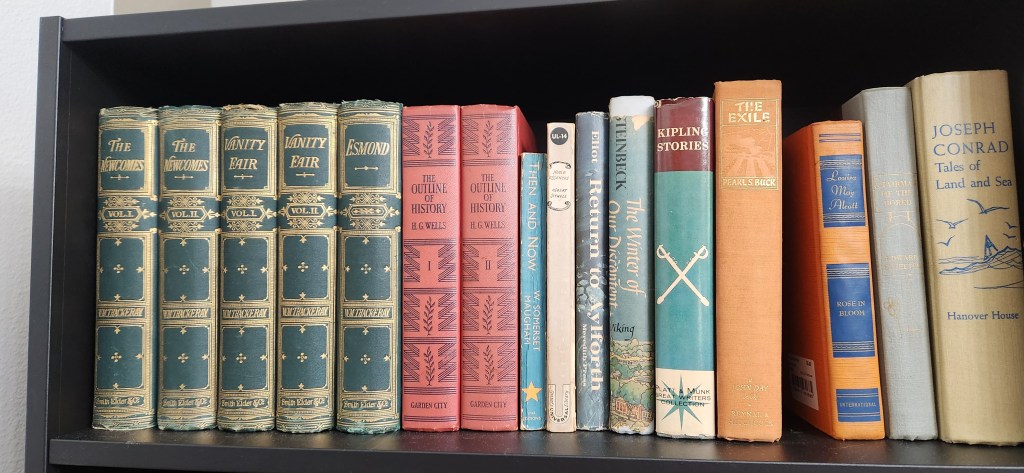
Yes, even if, like me, the ease of auto digital highlight features, custom fonts, and continuous scroll has made you something of a Kindle convert in recent years, there are still reasons to keep and acquire physical books.
Even if my first pass at a book is digital, I still try to buy a physical copy, or to find one in some out-of-the-way spot along the way. There are a few reasons that I find it incredibly valuable to keep the bulk of my library in the form of physical books—they set the scene for writing and reading, many of the books I own are antique or hold a personal significance, looking across them can remind me of the contents in a way that a digital library doesn’t replicate, and they also provide a window into your reading for other people that can help forge connection.
Setting the Scene
My first reason is something of a shallow one. I know that good writing can happen anywhere, and in any circumstance and that often, in waiting for the perfect conditions to magically coalesce around us, we create a chamber of impenetrable excuses that precludes even the faintest notion of words on the page until (and generally even after) those conditions are met. But, despite this, there is still something to be said for ambiance. I know that I can write from anywhere. But, my office full of roughly 1,000 books is still by far my favorite place to do it from. It’s really hard to view the writing of a 750 word article as insurmountable when a peek to your right reveals the full 66-novel retinue of Agatha Christie, who was doing it all from a typewriter and without aid of the internet.
If you surround yourself with writing that you admire, you’re reminded at every turn that it exists, and that there is therefore no excuse for a failure to create more of it beyond the lack of a desire to do so.
Historical and Personal Significance
I love nothing more than a beautiful vintage or antiquarian edition. I scour thrift stores, antique shops, and the local library book sale for specific books that I love in different editions.
I’m not going to falsely express myself as especially knowledgeable in this regard. I don’t know what the going rate is for this or that first edition. But I do know which books I personally love, and what I think is beautiful and worthy of holding on to.
I have books that friends and family members have gifted me with loving inscriptions in the front, like a birthday card you never throw away. I have books that friends gave to me because they were moving to small city apartments and couldn’t take them with them. Books I begged my mother for at Christmas in the 5th grade. Books that I bought because I asked the nice girl at the register in the book store which one she picked for the staff list, then bought it on trust alone after a good conversation. Books I’ve bought used, read myself, and lent to another friend or three, adding creases and careworn marks to the covers. And books I’ve bought new in fancy editions because they’re my particular favorites, so they stay in the cellophane until I need to revisit them. I have books from every place I’ve lived in, and most of the ones that I’ve visited. A glance at the covers reminds me of connections, conversations, ideas, and people.
One of my favorites in my collection is a set of five W.M. Thackeray editions published in 1869. They’re a rich emerald green with gold gilding across the spines and covers. Inside the front cover of each book in neat script is written “Alice Louise McDuffee, 1885”. When I look at these editions, I think about Alice, was she a young woman, or an old one? Were these beautiful editions a special extravagance, or was she a wealthy woman with a library brimming with editions just like it? These books, published 154 years ago, were as close to Alice as 2006 is to us, but I wonder if they felt that way.
Since I buy so many used old books from out of the way places, many of them have similar inscriptions to this one, either by the ostensible owner, or by the person giving the book to them as a gift. Sometimes even a line from the author.
There’s something very human and very physical in this. I think that sometimes a life focused heavily on research, and on reading and thinking can make a person feel disconnected, and that these tangible, undemanding reminders of other people in other moments are a uniquely connecting force.
The Physicality of Recall
I’m a piles of books person. Someone who stacks books up and surrounds myself with them. To me, this is the most natural inclination in the world. Even if my notes are digital, or I’ve highlighted in a kindle copy, there’s something about piling the books up in front of you that puts them into a mental group in a way that a computer doesn’t emulate for me.
The way this happens is quite different between fiction and nonfiction books.
For nonfiction, the books end up in a stack with printed out pdfs in the mix, and spread in front of me, and moved around, and sometimes thrown in with loose post notes until an order emerges from the chaos for how the argument or the essay is going to coalesce.
For fiction, I love to recommend books to people. It’s one of my favorite activities. Whether it’s based on a genre that they like, or I’m making a list of books that fit into a certain season or a trope, or some other literary convention, having the physical books to grab makes it so much easier to figure out what fits.
Conversation’s sake
Have you ever been in a friend’s house, or even at the party of a friend of a friend, and found yourself gravitating toward the bookshelves, trying to get a sense of the way this person you know interacts with and thinks about the world. If you’ve read this far about the atmosphere of books, you probably are just this type.
People’s taste in books can tell you a lot about what interests them. So can the way that they’re arranged.
Whenever I’m in an Airbnb, or a house staged for sale, or any liminal space that bookshelves have been inserted into as a decorative flair, I find myself scanning the spines, looking for favorites, and guessing if it’s a lovingly curated collection, or books sold by the foot for decor purposes based on nothing but cover color.
Looking at bookshelves in all of these spaces is entertaining, but there’s nowhere I enjoy it more than at a friend’s house. I’ve long joked with some of my friends that I would have known we’d be friends by looking at their bookshelves alone.
One of my oldest friends gave me a perfect glimpse into this recently. We were at her house. She had recently moved and hadn’t arranged her new bookshelves yet. We were drinking coffee in her kitchen—one of those far between aimless days with a friend that you get fewer and fewer of as adult life piles up. She knows how I am about books, so she asked if I’d like to help her arrange her new bookshelves. Instant yes. We moved the stacks of books from one room to another, chatting and picking up our coffees at intervals as we carried stacks between the rooms, shelving, categorizing, and deciding what belonged where.
We’ve been friends since junior high, and many of the books we’ve read have been things we came into together. That whole day we chatted about the books as we shelved them. The ones that we’d both read and could remember passing back and forth. The same golden and silver age science fiction picked up in early college, the Phillip K. Dick and Haruki Murakami books we picked up in high school. The books read for classes we’d taken together, or told each other about on the phone later when we were away at separate colleges. The philosophy books, and the classics we had in common. As we got older we’d send each other our own favorites as birthday presents, as if to say “read this piece of me you don’t yet know”. I sent her Brandon Sanderson, Douglas Adams, my favorite Agatha Christie. She Sent me Frederik Pohl and Kim Stanley Robinson. Our taste in books is inextricably linked. We learned to love these things together. I knew all of this, but going through her shelves that day really reminded me just how deep that connection was. Reading the same books, and at the same unique stages of life will connect people in ways that few things can.
Final Thoughts
Bookshelves are a way to catalog the foundations of your own thinking, and to show other people both what you’ve read and what you’d like to read.
The way that you organize and acquire books is intensely personal, and will vary by both preference and the physical limitations of space. That being said, even if you’re a fully digital reader, I encourage you to slowly curate a small selection of favorites.

 The Monkey's Typewriter